
Sunshine Coast Hot Water Frequently Asked Questions
The questions customers actually ask before they book, answered properly. Repairs, replacement, choosing between system types, and working with us.
These are the questions Sunshine Coast customers ask us most. Most hot water questions come down to one of three things: what has gone wrong, whether to repair it or replace it, and which system to put in if you are replacing. The answers below are grouped roughly that way.
Where a question genuinely depends on your property, we have said so rather than giving an answer that sounds decisive and turns out to be wrong at your place. Hot water is one of those areas where the honest answer is often that it depends on what you already have.
Frequently asked questions
Why do I have no hot water at all?
It depends on the system. On electric storage it is most often a failed element, a tripped safety switch or a thermostat that has stopped calling for heat. On gas it is usually ignition: a pilot that has gone out, or a fault in the gas control valve. On solar and heat pump it can be the booster, the pump or the controller. A photo of the unit and its data plate narrows it quickly.
Why is my hot water only lukewarm?
Lukewarm rather than absent usually means the system is still working but not fully. On an electric tank with two elements, one can fail while the other keeps heating, which halves your hot water and drops the temperature. On solar it often means the booster is doing all the work because the collectors or pump are not contributing. On gas it can be a partly blocked burner or a failing controller.
Why is my hot water system leaking?
Where the water is coming from matters more than how much. A drip from the relief valve is often normal during heating. Water from the tank itself, or a rusty stain running down the casing, usually means the cylinder has corroded through, and that is not repairable. Water at a fitting may just be a connection. Turn off the water supply to the system and call rather than waiting to see if it stops.
Can a leaking hot water tank be repaired?
If the leak is from a valve or a fitting, yes, and that is a routine repair. If the tank itself has rusted through, no. The cylinder is a sealed pressure vessel with an internal lining, and once that lining fails the steel behind it corrodes from the inside out. Patching it is not safe and not legal. A leaking cylinder is a replacement.
Is it normal for the relief valve to keep running?
A little discharge while the system heats is normal and by design, because water expands as it warms. A valve that runs continuously, or one that has recently started running much more, is not. It usually means the valve itself has failed or the water pressure feeding the system is too high. Left alone it wastes a surprising amount of water and can shorten the tank's life.
Why does my hot water system keep tripping the power?
Almost always a failed element. When the element's insulation breaks down, water reaches the live part and the safety switch does exactly what it is meant to do. Resetting the switch repeatedly is not a fix and is not safe. The element and usually the thermostat need replacing, and the tank should be checked at the same time to make sure it has not started leaking.
Why do I keep running out of hot water?
Three common causes. Parts that have worn, such as an element or a thermostat, so the tank never reaches full temperature. A leak on the hot water line drawing the tank down. Or a system genuinely too small for how the household now uses hot water, which often shows up after a bathroom is added or the family grows. Which one it is changes whether you repair or replace.
Why is my pilot light not staying lit?
Usually a dirty or failing thermocouple, which is the safety device that senses the flame and keeps the gas on. It can also be an accumulation of dust and debris around the burner, wind reaching the pilot on an outdoor unit, or a problem with gas supply to the system. Relighting it repeatedly without fixing the cause tends to be a short-lived solution.
Can you diagnose an error code on my system?
Usually, yes. Most modern gas continuous flow units and heat pumps show a numeric fault code on the controller or the unit itself, and the codes are manufacturer-specific. Send us the code along with the brand and model from the data plate. Some codes point to a simple reset, others to a part, and knowing which before we arrive saves you a visit.
What should I do if my system stops working?
If you rent, contact your property manager or owner first, and send them a photo of the system and its data plate so they can brief a plumber properly. If you own the property, turn the water supply to the system off if it is leaking, and look for anything obviously wrong: leaks, a gas smell, unusual noise, discoloured water, or a water meter running when nothing is on. Then call.
How do I know whether to repair or replace?
Age and the nature of the fault decide most of it. A tank in its first several years with a failed element or thermostat is usually worth repairing. A tank near the end of its life, one that has been repaired more than once, or any tank leaking from the cylinder itself, is usually worth replacing. Parts availability matters too, since some older models no longer have support.
How long should a hot water system last?
Most storage systems are replaced somewhere around the seven to ten year mark, though this varies a lot with water quality, how hard the system works and whether the sacrificial anode was ever changed. Some newer systems and some gas continuous flow units are expected to last longer, and their warranty length is a reasonable guide to what the manufacturer expects.
Can I replace my system with a different type?
Often, yes, but it depends on what the property already has. Moving from electric storage to a heat pump usually works well and needs somewhere outside with airflow. Moving to gas needs a gas supply with enough capacity. Moving to solar needs suitable roof space and orientation. We look at the existing connections first, because they decide what is practical and what it costs.
Can the new system go somewhere different?
Sometimes, and it can be worth doing. Relocating means new water lines and, depending on the system, new electrical or gas work, so it adds to the job. It is often worth it when the current position makes servicing difficult, when a heat pump would be too close to a bedroom window, or when moving the unit shortens the run to the bathrooms.
Do you remove the old hot water system?
Removal and disposal of the old unit is a normal part of a replacement, and you should expect any quote to say clearly whether it is included. It is worth checking on every quote you compare, because leaving an old cylinder on site is a genuinely annoying thing to be left with, and disposal is not free.
How is the right size chosen?
For storage, it comes from how many people live there, how many bathrooms, whether anyone takes baths, and whether hot water gets used at the same time in different places. For continuous flow, it is about flow rate rather than capacity: how many outlets might run at once. Both undersizing and oversizing cause problems, so it is worth getting right.
What should be included in a replacement quote?
The unit itself, installation, removal and disposal of the old system, any valves and fittings replaced as part of the work, and any electrical, gas or plumbing changes the new system needs. It should also be clear about commissioning and what warranty applies. If a quote is much cheaper than the others, the difference is usually in what it leaves out.
What is the difference between storage and continuous flow?
A storage system is essentially a large insulated kettle, heated by an element or a gas burner and kept at temperature ready to use. When it is drained it needs time to recover. A continuous flow system heats water only as it passes through, so it does not run out, but it is limited by flow rate rather than by capacity. Neither is better in general.
Is a heat pump right for my property?
Heat pumps suit properties with somewhere outside for the unit that has genuine airflow around it, a sensible distance from bedrooms and neighbours, and somewhere for condensate to drain. They use considerably less electricity than conventional electric storage, though the actual figure depends on the model, the climate, the installation and how the household uses hot water. The position is usually the deciding factor.
How much space does a heat pump need?
More than people expect. The unit needs clear air around it to work properly, because it is drawing heat from that air, and boxing it into a tight corner or a cupboard hurts its performance. Manufacturers specify minimum clearances and they vary by model. Noise matters too: a heat pump has a fan and a compressor, so under a bedroom window is a poor choice.
Is solar hot water the same as solar power?
No, they are separate systems that are easy to confuse. Solar hot water uses roof-mounted collectors to heat water directly, and has its own tank, pump and controller. Solar power, or solar PV, generates electricity for the whole house. You can have either, both, or one and not the other, and a heat pump paired with solar PV is a different approach again.
Can a heat pump run on my solar power?
It can be a good pairing. A heat pump uses electricity, so running it during the day when a solar PV system is generating means much of that electricity is your own. Many heat pumps allow you to set when they heat, which is what makes this possible. Whether it works well for you depends on your generation, your usage pattern and your tariff.
Is gas or electric better for my property?
It depends on what is connected and how you use hot water. Gas needs a supply with adequate capacity, and bottled LPG behaves differently from mains natural gas on both cost and refill logistics. Electric storage is simple and cheap to install but generally more expensive to run than a heat pump. The right answer is genuinely property-specific, which is why we look before recommending.
Does roof shading affect a solar hot water system?
Considerably. Solar collectors need direct sun, so orientation, tilt and anything shading the roof through the day all change how much of your hot water comes from the sun rather than the booster. A roof that is shaded for part of the day can still work, but the booster does more, which changes the running cost. This is worth assessing before committing.
What photos should I send?
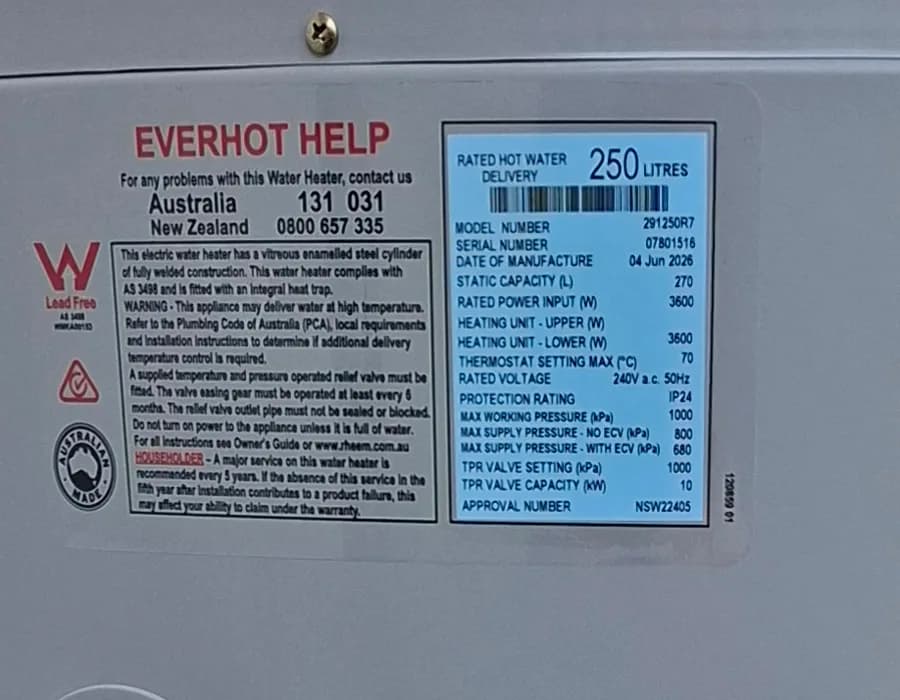
Three help most: the whole system from a couple of steps back so we can see how it is mounted and what is around it, a close shot of the data plate carrying the brand and model, and anything visibly wrong such as a leak or a rust stain. Between them they usually tell us the age, the type and the likely fault before we arrive.
Do you need to inspect the site before quoting?
Not always. For a straightforward like-for-like replacement, good photos and the model number are often enough for an accurate quote. An inspection matters more when the system is changing type, moving position, or when access looks difficult, because those are the things that change the price and are hardest to judge from a photo.
What warranty applies to the work?
RCM covers workmanship for 12 months on systems it supplies and installs. Beyond that the unit is covered by its manufacturer's warranty, and those terms vary by brand and model, so the booklet supplied with your system is the one that governs. Ask us to confirm both the workmanship term and the manufacturer's cover before you commit, and we will put them in writing on the quote.
Does a hot water system need servicing?
Yes, though what and how often depends entirely on the type. Manufacturers set their own requirements, and some warranties depend on them being met. Solar systems have pumps, controllers and roof-mounted parts that benefit from being checked. Heat pumps have filters and airflow to keep clear. Storage tanks have a relief valve and an anode. There is no single universal interval.
What licences does hot water work require in Queensland?
Hot water work involves water, gas and electricity, and in Queensland the relevant work is licensed. Gas work and plumbing work each require the appropriate licence, and electrical connection work is separately licensed again. Whoever you use, it is reasonable to ask which licences they hold for the specific work your job involves, and to be given the numbers.
What areas do you service?
We work across the Sunshine Coast and the hinterland, including Noosaville, Cooroy, Nambour, Maleny and the Glass House Mountains. We also travel further north and south, but those trips are on different terms and are worth confirming before you book. The service areas page sets out which is which, and calling is the fastest way to get a straight answer.
How quickly can you get to me?
Call and ask, because it depends on the day and where you are. A job inside our regular Sunshine Coast area is a very different proposition from one at the edge of the extended areas. We would rather tell you honestly when we can be there than give you a number that sounds good and then miss it.
Licensed, qualified and local
QBCC Licensed
Licence 15045345
Verify this licenceGas Work Licensed
Licence L93578
Verify this licenceRestricted Electrical
Licence 158711
Verify this licence
Related services
Still not sure what your system is doing?
Send a photo of the unit and its data plate. That usually answers it faster than any list of questions.
RCM works across Sunshine Coast and the hinterland. See the full Sunshine Coast service area for where we work regularly and where we travel on different terms.
RCM Hot Water on Google for the listing, opening hours and reviews.