
RCM Hot Water
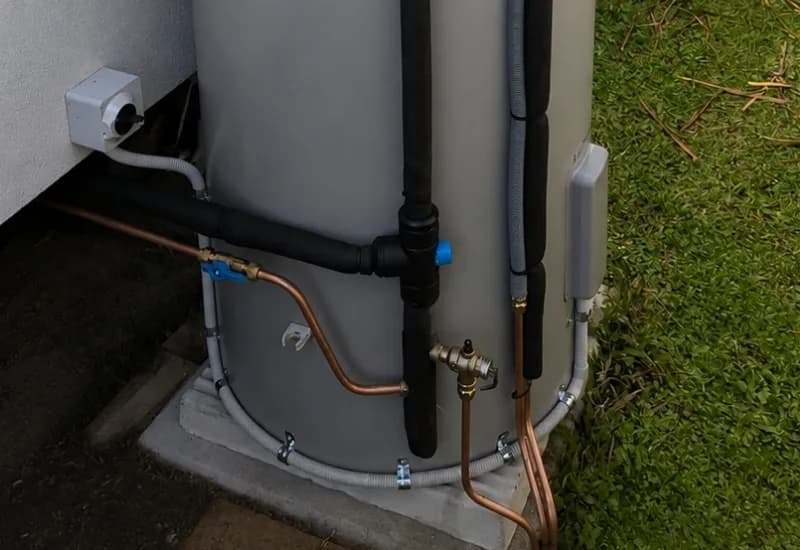
Lagged flow and return pipework, isolation valve and condensate line at the base of a heat pump installed by RCM

Hot Water Repairs Sunshine Coast

No hot water, not hot enough, running out, leaking or tripping the power. We work out what has actually failed before quoting anything.

RCM diagnoses and repairs heat pump, solar, electric, gas and continuous flow hot water systems across the Sunshine Coast. Most calls are one of a small number of faults, and most of those are repairable.

The part that matters is the diagnosis. A system that has stopped producing hot water can be a twenty minute fix or a finished cylinder, and those two have very different answers. We would rather find out which before quoting than sell you a replacement you did not need or a part that buys you a fortnight.

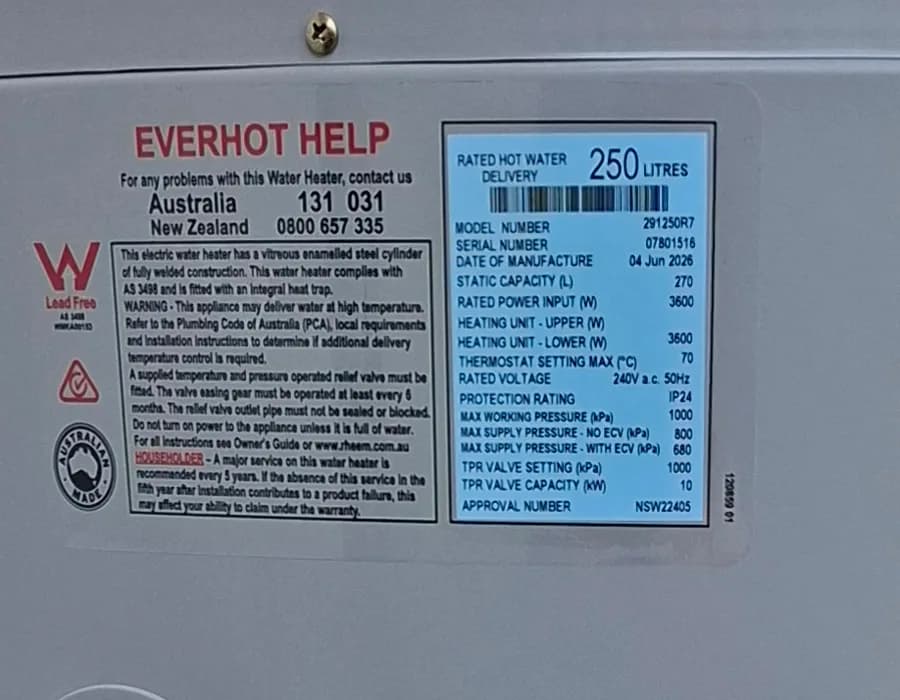
The data plate on an Everhot 250 litre storage tank, showing model, serial number, capacity and element ratings

What your system is doing, and what it usually means

No hot water at all. On electric storage this is most often a failed element, a tripped safety switch or a thermostat that has stopped calling for heat. On gas it is usually ignition: a pilot that will not stay lit, or a fault in the gas control valve. On heat pump and solar it can be the booster, the circulation pump or the controller.

Not hot enough, or running out sooner than it used to. On a twin-element electric tank, one element can fail while the other keeps working, which roughly halves your hot water. It can also be a thermostat drifting, a leak on the hot line quietly drawing the tank down, or a system that was always slightly small for the household and has finally been noticed.

Temperature that moves around while you are using it. On continuous flow this usually means demand is exceeding what the unit can deliver, so a second outlet opening drops the temperature at the first. On storage it more often points at a tempering valve.

Water where it should not be. A drip from the relief valve during heating is normal and by design. Water from the tank body, or a rust stain running down the casing, is not, and generally means the cylinder has corroded through.

Tripping the power. Almost always a failed element letting water reach the live part, with the safety switch doing exactly its job. Repeatedly resetting the switch is not a fix and is not safe.

Noise, discoloured water, or an error code on the controller. Noise is often sediment in the base of a tank. Discolouration can be corrosion inside the cylinder. Error codes are manufacturer-specific and worth sending us before we come out, because some point at a reset and others at a part.

How we diagnose it

We start with what the system is doing and what changed, because the symptom narrows the cause a long way before anyone touches anything. Then the data plate, which tells us the type, capacity and age, and whether parts are still supported.

From there it is the usual suspects for that system type, checked in the order that rules out the most for the least work: supply and isolation, then the controls, then the heating components, then the tank itself. The tank is checked last and matters most, because a sound cylinder means almost everything else is repairable and a failed one means nothing else matters.

You get told what we found and what the options are before work proceeds, not afterwards.

What we commonly replace

Elements and thermostats on electric storage. Thermocouples, gas control valves and igniters on gas. Circulation pumps, controllers and booster elements on solar. Fans, and occasionally compressors, on heat pumps. Relief valves and tempering valves across all of them, since those wear and are cheap relative to the damage they cause.

Most of these are routine. The judgement is not usually whether a part can be replaced, it is whether replacing it on a system of that age is the right call, which is the repair-or-replace question.

When a repair stops being the right answer

A leaking cylinder ends the conversation, at any age. The tank is a sealed pressure vessel with an internal lining, and once that lining fails the steel behind it corrodes from the inside. It cannot be patched safely or legally.

Short of that, it is a judgement about age, repair history, parts availability and how the repair cost compares with a replacement. A system on its third fault in a year is funding a replacement in instalments.

We set out how we weigh that on the repair-or-replace page, including the cases where repairing is clearly the better decision.

What makes a repair cost what it does

The part, whether it is still supported and how quickly it can be obtained. Access to the system, since a tank in a tight internal cupboard or a roof space takes longer than one against an external wall. Whether the work is scheduled or urgent, since out-of-hours work costs more. And whether the diagnosis is straightforward or the fault has to be chased.

We would rather tell you the range and what would move it than quote a number that changes when we arrive.

When to stop reading and call

If you can smell gas anywhere near the system, leave it, ventilate if you can do so safely, and call. If water is running from the tank body rather than dripping from a valve, turn off the water supply to the system and call: a failed cylinder can put a lot of water into a wall cavity or under a slab in a few hours.

If the system is repeatedly tripping the switchboard, leave the circuit off and call. Resetting it repeatedly defeats the protection that is doing its job.

What to send before we come out

  1. 01

    A photo of the whole system

    From a couple of steps back, so we can see the unit, how it is mounted and the pipework around it.

  2. 02

    A photo of the data plate

    The label carrying brand, model and capacity. It tells us the age and whether parts are still supported.

  3. 03

    The symptom, specifically

    No hot water, lukewarm, running out, a leak, a noise, a tripping breaker, an error code. Each points somewhere different.

  4. 04

    When it started

    Sudden or gradual, and whether anything changed around the same time. Gradual and sudden faults have different causes.

Google Reviews

Reviews published on RCM’s Google listing, reproduced with the names as they appear there.

Write a review

  • Paul Donovan

    Solar hot water repair

    5 out of 5
    Richard (RCM Hot Water) was superb in his tenacious problem-solving in which the solution was far from obvious and ultimately required ruling-out several potential problems to restore our solar hot water system to full working order. I would most definitely use his cheerful services again... and again...

These are reproduced from RCM’s Google reviews with the names as published. This is a selection rather than the full set. Read them all on Google

Licensed, qualified and local

Frequently asked questions

Can you repair my brand of hot water system?

We repair heat pump, solar, electric, gas and continuous flow systems across the common brands. What decides it is not usually the badge but whether parts are still available for that model, which is why the model number from the data plate is the most useful thing you can send us before we come out.

How quickly can you look at it?

Call and ask, because it depends on the day and where you are. A job inside our regular Sunshine Coast area is a different proposition from one at the edge of the extended areas. We would rather give you an honest answer about when we can be there than a number that sounds good and then slips.

Will you tell me if it is not worth repairing?

Yes. If the cylinder has corroded through, a repair is not something we can responsibly offer, and we will say so rather than sell you a part that buys a fortnight. Equally, if the tank is sound and the fault is a component, we will repair it rather than push a replacement you do not need.

Do I need to be home?

Usually yes, at least for access and to talk through what we find. If the system is outside and reachable, and you are comfortable with us proceeding on the basis of a phone conversation, that can sometimes work. Say which you would prefer when you book so we can plan the visit properly.

What if it fails again after the repair?

Talk to us. Workmanship on repairs we carry out is covered, and any part we supply carries the manufacturer's warranty on that part. A system that fails again shortly after a repair is usually telling you something about its overall condition, and that conversation is worth having properly.

Should I turn anything off before you arrive?

If water is coming from the system, turning off its water supply limits the damage while you wait. Beyond that, leave it alone. Do not open panels, reset switches repeatedly, or attempt anything on the gas or electrical side. Those are licensed for good reasons and a hot water system holds water under pressure.

Hot water not behaving?

Send a photo of the system and its data plate, or call and describe what it is doing.

RCM works across Sunshine Coast and the hinterland. See the full Sunshine Coast service area for where we work regularly and where we travel on different terms.

RCM Hot Water on Google for the listing, opening hours and reviews.